Leadership Decision Dynamics™ maps the collective behavioral makeup of your leadership team so you can see which perspectives dominate, what may be missing, and where that could create risk in the way the company is led.
For leadership teams, executive teams and boards making decisions that shape the future of the business.
Every leadership team has a natural behavioral shape. Some teams move quickly and act decisively. Some interrogate every risk. Some generate possibilities and bring others with them. Some protect stability, cohesion and execution.
Each of those tendencies can be valuable. The risk appears when one perspective dominates or another is not naturally represented in the room.
If any of these sound familiar, this work may be valuable:
“We have capable people around the table, yet we keep revisiting the same decisions.”
“We move quickly, then discover implications we didn't fully consider.”
“We analyze decisions thoroughly, although it can take us too long to commit.”
“Everyone agreed in the meeting, then the decision didn't translate into action.”
“The same person always has to challenge the group's thinking.”
“We know one another well, but we have never examined what we are collectively predisposed to overlook.”
Different symptoms can point to the same underlying question:
What is the behavioral composition of your leadership team causing you to see clearly, and what might it be causing you to miss?
.webp)
An individual behavioral profile can help a leader understand how they naturally operate, communicate, make decisions and respond under pressure. That is useful. It is not the whole picture.
When we map the leadership team together, we can see the collective patterns that no individual report reveals:
Which behavioral perspectives naturally dominate the room.
Which perspectives are underrepresented or missing.
How the team is likely to approach pace, risk, opportunity, challenge and implementation.
Where the group may become less balanced under pressure.
Whether an important perspective depends too heavily on one person.
Where collective tendencies may create blind spots in business decisions.
The profiles give us evidence. The collective interpretation is the value.
Leadership Decision Dynamics™ is a behavioral analysis and advisory process for the people responsible for leading the business.
We use Extended DISC® to understand each leader's natural behavioral style. We then map the team as a whole and interpret what its collective composition means in the context of the company, its priorities and the decisions ahead.
The purpose is not to label people or decide that one style is better than another. It is to give the team a clear view of:
The perspectives it brings naturally.
The perspectives it may need to introduce more deliberately.
The risks its collective wiring may create.
How pressure may change the way the team operates.
What should be built into leadership discussions and decision-making so important considerations are not missed.
This is where Sel's advisory expertise matters. The assessment produces the data. Sel determines what it means for the way your company is led.
The capacity to challenge, decide, move quickly and push for results.
The capacity to see possibility, generate energy, persuade and bring an external or future-focused perspective.
The capacity to listen, create consistency, consider people and support dependable implementation.
The capacity to test assumptions, examine risk, establish standards and protect accuracy.
Leadership Decision Dynamics™ shows where the team may need to slow down, speed up, challenge harder, widen the conversation or build a missing perspective deliberately into the decision process.
We begin with the business context, the leadership team and the important decisions ahead.
The analysis must be grounded in what the company is trying to achieve, not interpreted in isolation.
Each leader completes an Extended DISC® assessment and meets individually with Sel.
The interpretation goes beyond a standard style description to explore how the person leads, makes decisions, responds under pressure and contributes to the collective team.
We map the leadership team as a whole to identify dominant patterns, underrepresented perspectives, concentration risks and potential blind spots.
Sel facilitates a leadership advisory session that translates the map into practical implications for the business.
The team agrees where it needs more deliberate challenge, what must be introduced into key decisions and how it will use the insight going forward.
A shared view of the team
Understand how the leadership team is collectively wired, rather than relying on assumptions about individuals.
Visible decision-making blind spots
See which perspectives may be overlooked when the team assesses risk, opportunity, pace, people and execution.
More deliberate challenge
Know when the group needs to slow down, widen the conversation or bring in a perspective that may not arise naturally.
Better use of each leader
Recognize who naturally contributes which perspective and avoid depending on one person to provide the team's only counterbalance.
Practical leadership guardrails
Build the missing questions and perspectives into the way important decisions are discussed and made.
A language the team can keep using
Give leaders a shared, neutral way to recognize behavioral differences without reducing people to labels.
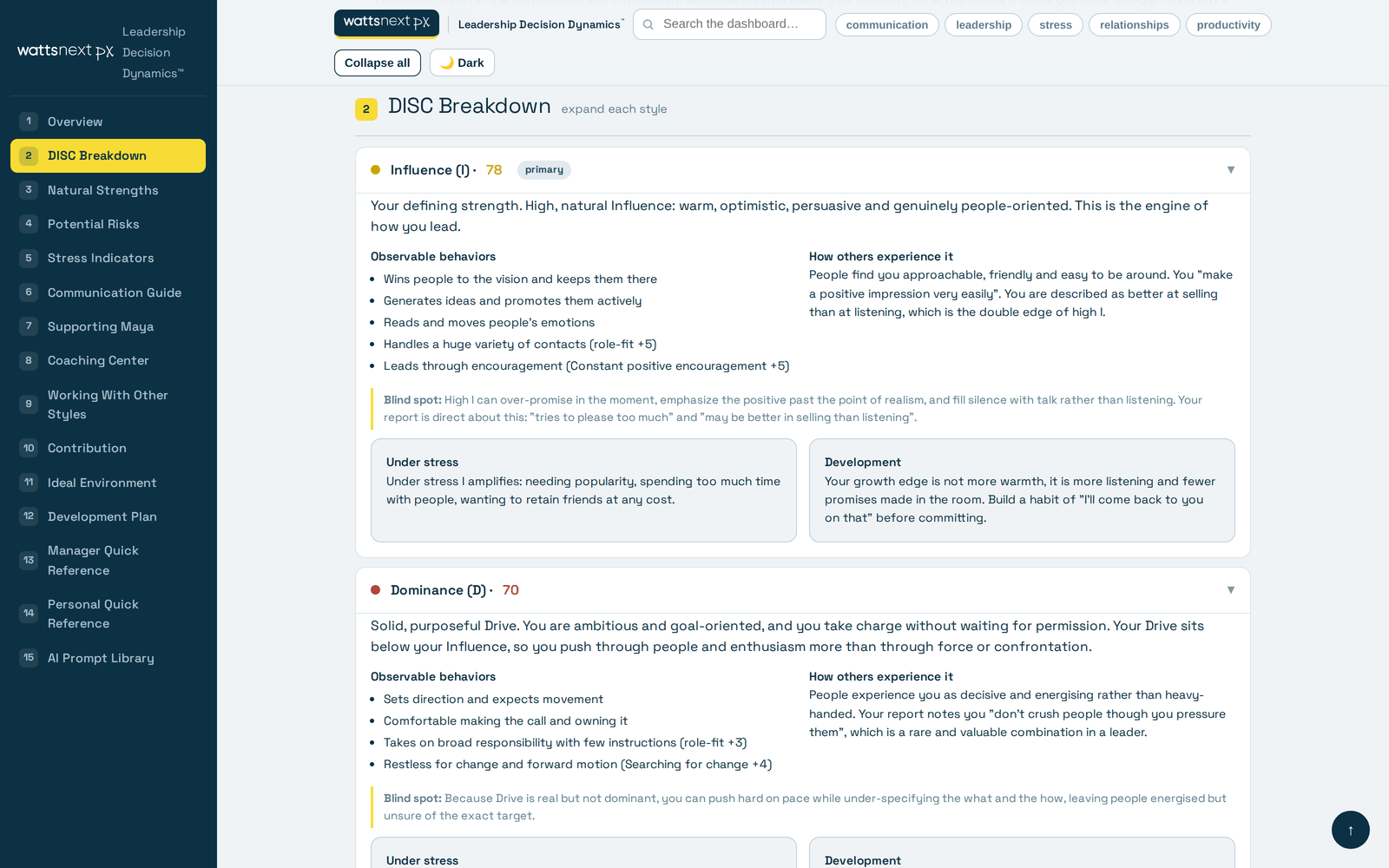
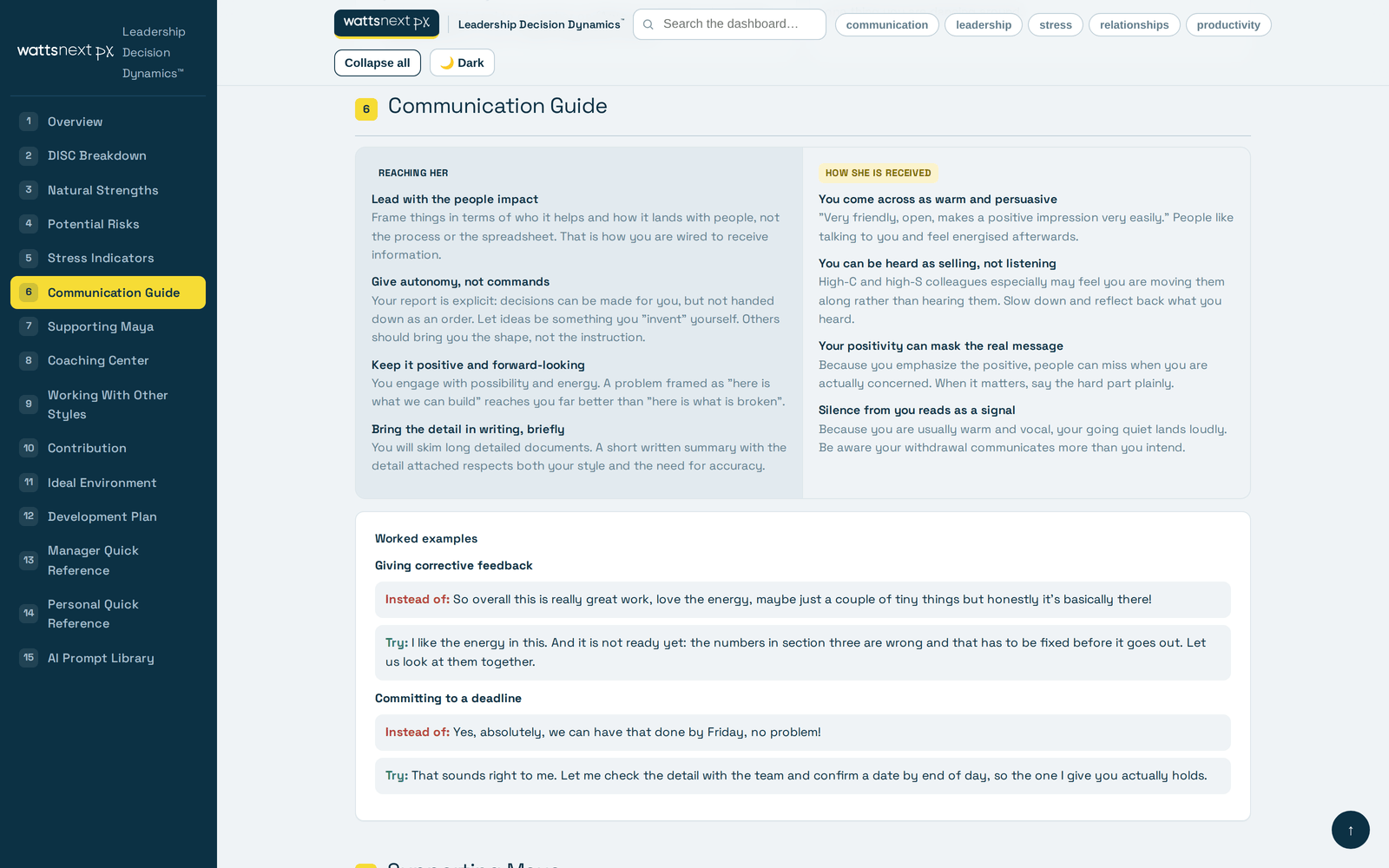
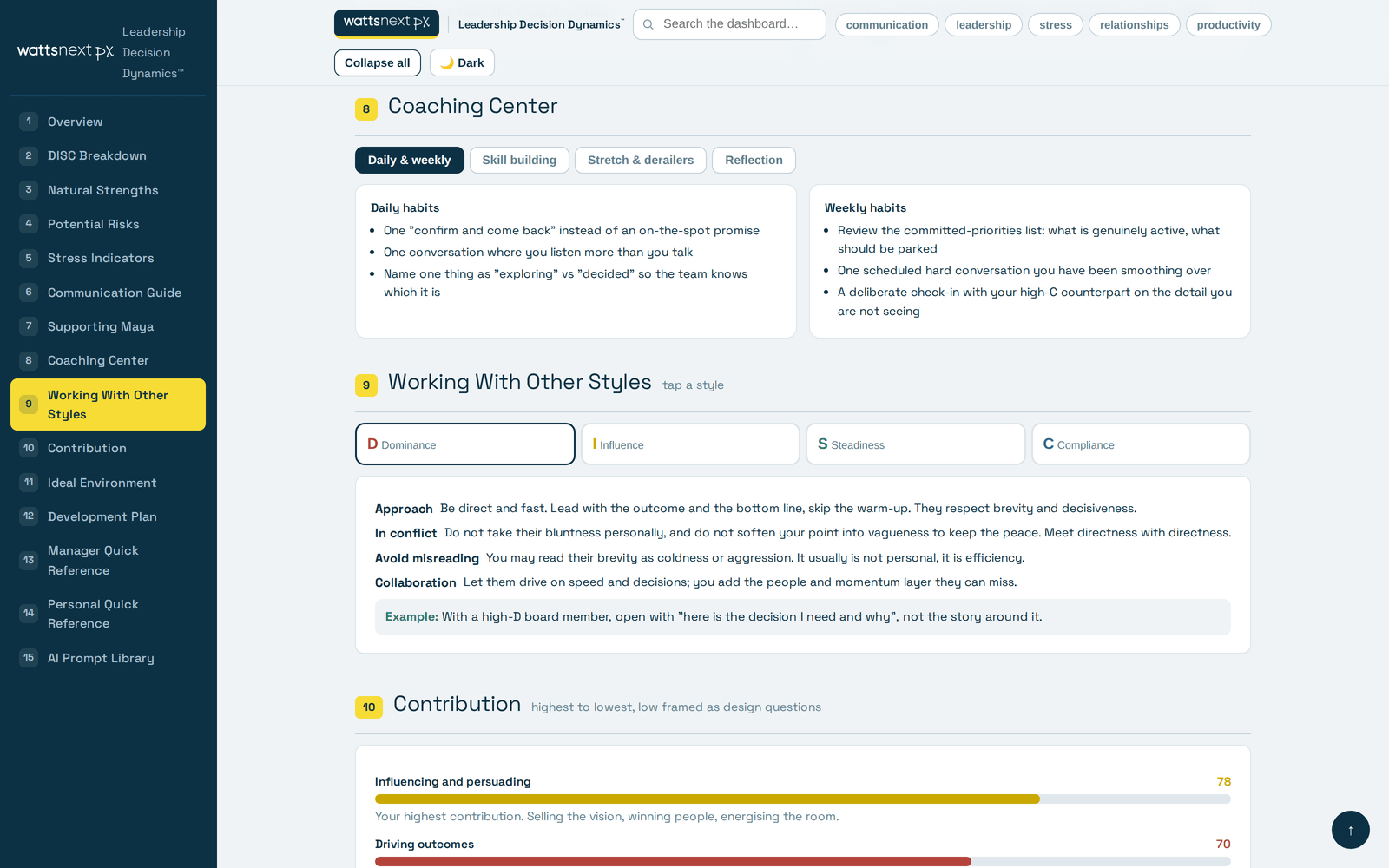
The AI Behavioral Insights Dashboard
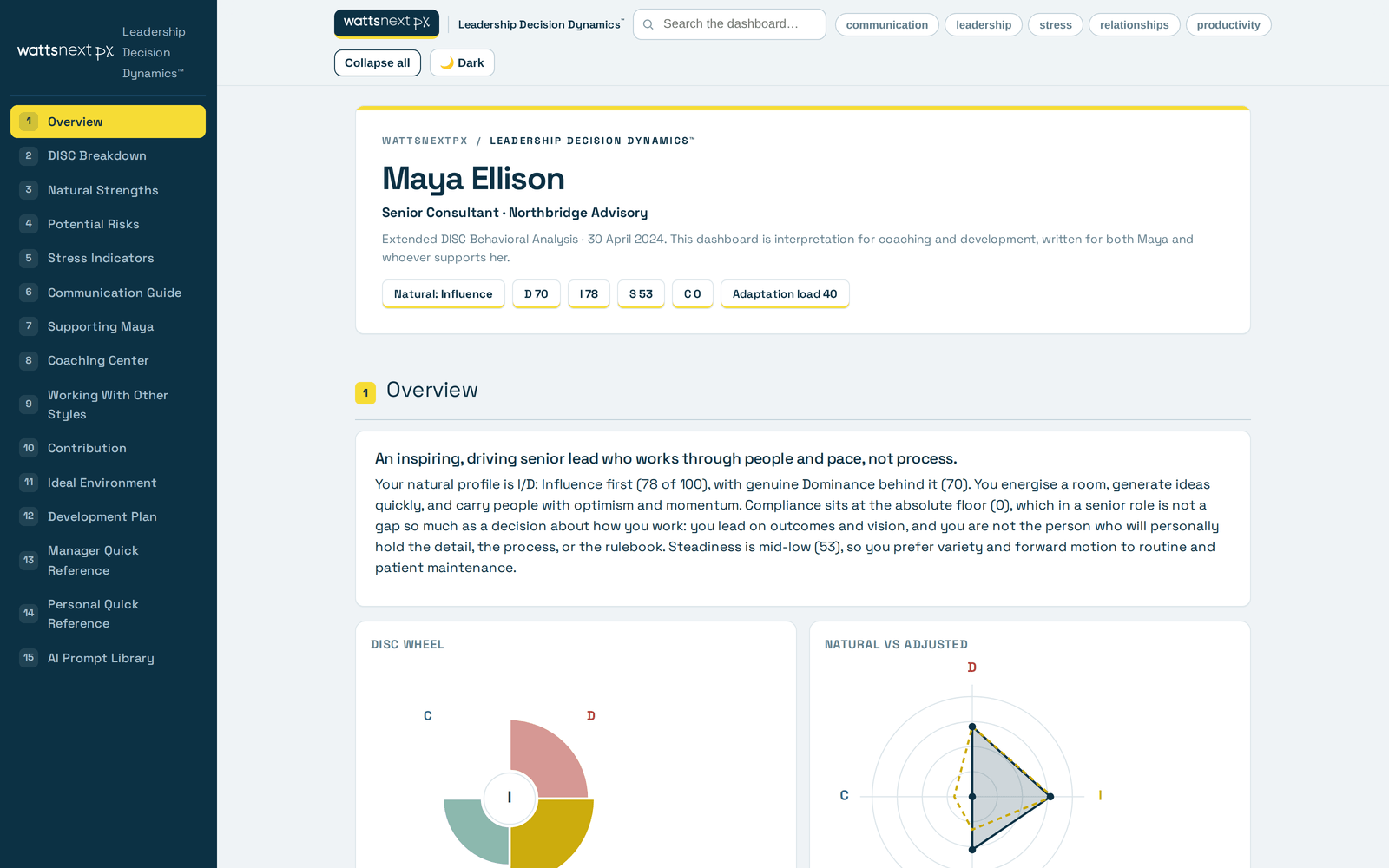
Each leader receives access to an AI Behavioral Insights Dashboard that turns their profile into something they can continue exploring and applying.
Leaders can use it to examine:
Their natural strengths and behavioral tendencies.
How they are likely to operate under pressure.
How others may experience their style.
How to work more effectively with different behavioral styles.
Practical coaching insights they can apply in real situations.
The dashboard supports ongoing use. It does not replace Sel's interpretation of the individual or collective team.
A preview of the dashboard. Each leader receives their own.
The dashboard makes the insight accessible. The advisory work makes it commercially meaningful.
Leadership Decision Dynamics™ may be particularly valuable when:
A founder is building or reshaping the senior leadership team.
A significant new executive is joining the business.
The leadership team is preparing for growth, succession, investment or an eventual exit.
The company is making decisions with greater complexity, risk or financial consequence.
Leaders know one another well but have never examined their collective behavioral composition.
The same tensions or decision patterns keep appearing.
The team needs to make better use of different leadership perspectives.
A board or executive team wants greater rigor in the way it challenges and reaches decisions.
Individual DISC profiles already exist, but no one has translated them into a meaningful collective picture.
This work is designed for leadership teams, executive teams and boards. It is not a broad employee personality exercise.
Sel Watts has spent 20 years interpreting behavioral profiles in the context of leadership, roles, teams and business performance.
She brings more than technical assessment knowledge. She understands how businesses operate, how leadership teams make decisions and how behavioral patterns affect accountability, risk, execution and growth.
That combination matters because a behavioral profile should never be read as a list of isolated traits. The same result can be a strength in one role, a risk in another, and exactly what a leadership team is missing. The value lies in understanding the context.
Sel does not simply tell leaders what their profiles say. She shows them what the collective picture means for the way they run the company.
.webp)
Is this a team-building workshop?
No. Better working relationships may be one outcome, but the primary purpose is to understand how the team's collective behavioral composition may influence business decisions.
Is one behavioral style better than another?
No. Every style brings value and every strength can create a corresponding risk when it is overused or not balanced by another perspective.
Does a missing style mean the team lacks that capability?
Not necessarily. It means that behavior or perspective may not arise naturally or consistently within the group. The work helps the team decide how to introduce it deliberately when it matters.
We have already completed DISC. Can we still do this?
Possibly. Sel can review what already exists and determine whether the profiles provide the information required for a meaningful collective analysis.
Is this only for teams experiencing conflict?
No. A highly functional team can still share the same blind spots. This work is particularly valuable before major decisions, during growth or when the composition of the leadership team is changing.
Can this be used when appointing a new executive?
Yes. The profile should never be used as a pass/fail hiring test. Interpreted properly, it can help the company understand how a candidate is likely to approach the role and what perspective they may add to the existing leadership team.
.webp)
If you have never mapped the behavioral composition of the people leading your company, Leadership Decision Dynamics™ will give you a view that individual profiles cannot.
Book a call with Sel →Prefer email? Contact Sel directly at sel@wattsnextgroup.com.
See the team. Strengthen the decision.
Behavioral insight translated into practical advice for leading the business.